Showing posts with label ETHICAL TRADE. Show all posts

Tuesday, August 19, 2008

Conference!


Well, I'm sure some of you know that a little over a week ago I was in Hungary....why Hungary literally a few days after finding my feet back in England from Phnom Penh? Well, my brother was leading a conference for GEM-Ks and he was short staff, the theme of the conference was being taken from a book that I had just read, and I was still unemployed, so it worked out that I was able to go.  And I'm so thankfull that I did, it was such a great week! 

So this was probably my, I don't know, 7th conference....I went I think 5 times as a teenager, and once as a leader 4 years ago literally on the way back from spending the summer in Jordan.

If you want to read more about the week go to another leader's Michaela's blog.  She has a much more in-depth summary of what went on.    

Here's some thoughts of mine that I wrote a couple of days after coming back that is perhaps an example of some of the things we were discussing through the week.  

----
Wednesday 13-08-08
East Waterloo Train Station, London

-So at conference we were using the book J4P as a basis for our discussions.  Analisa brought up the point about our conflicting values of justice and thrift.  We've been taught so well to buy good deals, when things are on sale, or at discount stores, so that we don't spend more than we should.  But then when we were talking about how often these low prices don't capture the entire cost of their production and often feed our system of oppression and hyper-consumption then we find that we have a system where our values are in conflict.  
I was thinking about thrift.  I truly believe in this value, I buy many of my clothes and possessions cheaply at 2nd hand shops or discount stores.  I never buy things at full price it's just not in my nature.  But does this thrift have a purpose?  I think it was John Wesley who said, "Earn a lot, spend a little, give generously" (or something like that).  We've got perhaps the first two down.  But I really think that at least personally, my thrift only enables me to consume more, rather than give sacrificially.  The money gets spent, I just make it go farther.  So in this instance is my thriftyness really of any value anyway? What is it's kingdom purpose or is this just a relic of calvanistic culture that has been passed on divorced from it's original intentions? 

-----

Is our system of cheap prices for everything from alarm clocks, coffee, t-shirts and throw-away cups at fast food restaurants really capturing the cost of producing them? Or are we actually relying on a system of exploitation (exploiting cheap labour, exploiting the environment) just to feed our consumption?  If we read the section of the bible where the prophets are putting into words God's anger for the stuff that his people are doing, exploitation is one of the biggies. But is it too ingrained in our system for us to truly break out of it? 

Sunday, March 25, 2007

Easter thoughts....

Today at church, we were reflecting on 200 years since the end of the trans-atlantic slave trade. So one of the things we did, was look at slavery today, and how most of us benefit from it.

Especially as we're coming up to Easter, I thought it was poignant that my pastor decided to do a presentation on the chocolate industry and slavery. An estimated 15,000 Malian children work as slaves on Ivorian cocoa plantations. Cote D'Ivoire supplies 43% of the world cocoa to the main chocolate producers in Europe and America. Chances are the chocolate that you will eat this Easter, much of it will have been at the cost of forced labour and beating of children.

I'm sure this isn't shocking to most people as this made big news back in 2001. Then there was supposed to have been a voluntary code set up by the Chocolate manufacturers to ensure that child slavery was ended on cocoa farms by 2005. Sadly this hasn't been met. Here's a excerpt from the american Global Exchange (fair trade) website:

"In 2001, this unacceptable practice caught the attention of the media and the government, and the American public began to voice their abhorrence of the use of child slave labor in the production of one of their most beloved treats: chocolate. In response, the US chocolate industry agreed (via the Harken-Engel Protocol) to voluntarily take steps to end child slavery on cocoa farms by July of 2005.

Unfortunately, this deadline has now passed, and the chocolate industry has failed to comply with the terms of this agreement. As a result, Global Exchange is spearheading a campaign that will provide an opportunity for communities nationwide to voice their concerns about the chocolate industry's abuse of children's rights."

This is still an important issue! In the words of one Malian child slave, "Tell your children that they have bought something that I suffered to make. When they are eating chocolate they are eating my flesh." (this quote come s from Stop the Traffik.org)

Okay, so is there anything we can do about it? Pray, that's a good start. When you see easter eggs for sale in the shops (or chocolate bunnies if you're in america) stop and pray.

But there's more that we can also do, sometimes I think we use prayer as a way to take away personal responsibility, I know I do, but there is a lot that we can actually do.

Antislavery.org doesn't recommend boycotts of buying chocolate, as this often does more harm than good, hurting already poor farmers who don't use slaves, and encouraging more farmers to use slave labour as the demand for their goods (and their income) falls.

Instead they recommend supporting fair and ethical trade initiatives. Although I don't think Fair Trade is a viable long term solution, as it is too controlled in terms of market forces, for the moment it seems a good way to guarantee, and encourage fair working conditions. If the world was free and equal, then free trade would be the way to go, but without common respect for human rights (and general love of neighbour), free trade leads to exploitative practices with increasingly lower wages and higher profits. Buying Fair Trade on the other hand, guarantees good fair wages for those who have produced and sees them through times of market fluctuation. Although the fair trade component of Cote d'Ivoire's cocoa production makes up only 1.3% of the market it is growing. The more larger producers see the rise of Fair Trade chocolate sales the more they will be be compelled to look at their own buying practices in order to retain their share of the market.

Other than that we can support Ethical Trade Initiatives, by encouraging your family to sit down this easter and write a letter to one of the chocolate producers, encouraging them to increase their efforts to guarantee just labour practices. (I've put a few addresses at the end but local ones shouldn't be too hard to find.)


On Easter we choose to celebrate the crux of our faith, there is victory over death and the destructive pattern that we are part of in this world will not prevail. Let's continue to try and live that way now, and in God's power (through Christ's ressurection) we know that it's possible.


Addresses:
Corporate Affairs Manager
Nestlé UK Ltd.
St. George's House
Croydon
Surrey
CR9 1NR

External Relations Department
Mars Confectionery
Dundee Road
Slough
SL1 4TS

Terry's Suchard/ Kraft Foods
Consumer Care
St. George's house
Bayshill Road
Cheltenham
GL50 3AE

Consumer Relations Department
Cadbury Ltd.
PO Box 12
Bournville
Birmingham
B30 2LU

Sunday, January 21, 2007

Why Western governments' foreign + economic policy matters....

I got this from the charity OXFAM's website.


Access to medicines

Life-saving drugs under threat in Thailand

Thailand's national HIV and AIDS treatment programme has succeeded in providing cheap drugs to 90 per cent of the people who need them.

However, the US push for a Free Trade Agreement with Thailand threatens the future of the treatment programme by enforcing stricter patent rules. This could increase the price of new and improved AIDS drugs by as much as 90 per cent, costing the Thai government up to $3.2 billion and putting thousands of lives at risk.

For Solada, the availability of affordable medicines is a matter of life or death. She is 43-years-old and HIV-positive. She is currently receiving medicine through the government treatment programme. She lives with her husband who is a casual labourer, and her 16-year-old son. Sewing bags for a living, she is the family's main breadwinner. "When I first learnt I was HIV-positive I couldn't accept it," she says. "But now, because of the treatment I receive, I feel alive. I'm born again."

Experts say that about five per cent of drug recipients each year develop resistance, as the HIV virus mutates. When this happens, new and improved drugs are required. These medicines are expensive as they are patented by international drug companies. The current prices charged by companies for these drugs ($6,782) are more than ten times the cost of cheaper copies currently provided by the government ($482). If the US and pharmaceutical companies get their way, life-saving drugs will be priced out of the reach of Thailand’s poor people.

Isra is a 34-year-old dried seafood retailer living with HIV. Without support from Oxfam, he would be unable to pay for his HIV treatment, which costs twice what he earns per month. "I want drug companies to make drugs affordable," he says. "The new drugs are expensive. I think they should also be part of the government programme, as people on my income can't afford to buy them. I get depressed and stressed when I think of it. I have no choice, I want to survive. I need these drugs."

Source:
The economics of effective AIDS treatment: evaluating policy options for Thailand (World Bank; 2006), by Ana Revenga , Mead Over , Wiwat Peerapatanapokin , Sombat Thanprasertsuk , Emiko Masaki , Viroj Tangcharoensathien , Julian Gold.

Act now - email Novartis CEO Global drug company, Novartis, must stop denying India the right to produce cheaper medicines for poor people worldwide!


Sunday, November 26, 2006

CROSS-ATLANTIC SOCIAL JUSTICE CHRISTIANITY

(So, being back home for the week was great. I really enjoyed it and got almost no work done, so I'm really going to have to lose my social butterfly mentality and get some work done these last 3 weeks before Christmas. By the way my brother is still in hospital, healing extremely slowly, and pretty much would do anything to get out of there, so keep him in your thoughts and prayers. )

So I've only been in the U.K. for a little over 2 months now but there's something that I've been noticing, and even though I'm not here that long yet, I still want to begin commenting on it.

Over the past 4 years when I was studying at Wheaton, I found myself involved with Christians who had a particular understanding of what Jesus' message was all about, it was my interaction with these people, communities, and ideas, along with God's incredible grace that kept me from throwing away my faith altogether. There's lots of ways people use to describe these Christians; some involve big theological definitions, some other terms are more derogatory, but the one (which I still don't like, but which I think most people understand) is basically these were "social justice" christians or maybe a better one is "wholistic" Christians. These people were trying to understand and live out the message of Jesus which involves both word and deed, basically speaking love and showing love.

Anyway, naturally being in a new place I've been trying to connect myself with these types of christians here, and I have found some really good groups of people. It's interesting though, but I'm finding that although these people hold sort of the same understanding of Christianity as my friends back at Wheaton did, their approach and ideals are quite a bit different. And I think that's a really good thing, the more i look into it the more i think we have to learn from one another.

Christians I've met in the UK are passionately concerned with structural, societal and environmental justice. They campaign for issues such as Fair Trade, and buying Organic food. They advocate what people call "Ethical" living. What I've come to understand by that term is that it means, trying to live a life where your purchases were produced fairly and safely, where you're day to day life has as little negative impact on the environment as possible and where even the money in your bank account savings is not being invested in unethical activities (such as the arms-trade).
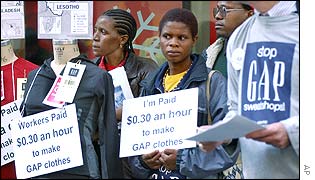
These Christians wouldn't wear Gap (probably close to a sin), or buy "super cheap" things (at places like Primark- like a K-Mart), because if something is super cheap it has most likely exploited someone.

There is the understanding here that if you spend just that bit extra you are ensuring justice for the person you've bought it from (of course it's not that simple, but that's the general gist).



Churches hold Fair Trade Sales, and at my church a woman sells ecologically friendly cleaning supplies everyweek at the back by the information table. The last church I visited had successfully campaigned to have Southampton become a Fair Trade city.

In America however, although SJ christians are aware of these issues(Fair Trade, organic, non-GM modified food) they are not the focus, and usually less effort is put into them (I think i'd make an exception for Shane Claiborne though...who makes his own clothes). More effort/intention goes into the personal and relational side of justice issues. More common issues such as: where you live (whether in the subarbs - a seemingly cardinal sin- or in shafted areas -i.e. 'where Jesus would live......'), Racial Reconciliation, Who you spend you're time with, and Learning not Teaching become primary.

The mantra of some of the American SJ christians might be as Viv Grigg said (I think quoting someone else) "Earn as much as you can, Spend as little as you can and Give generously." People frequent the shops that UK SJ christians would think sinful, they buy the super cheap foods, they buy the super cheap clothes (well in fairness few clothes are bought at all, holes are a matter of spiritual maturity wherever you go). But they do this for the greater value of "identifying" with others, with the outcast and the shafted. The way of life is rather called "Simple Living" on that side of the pond.

I have to admit I'm not here long enough to even begin trying to understand UK multi-ethnic relations, from what little i've talked to people, I keep getting different opinions, and all I can tell so far is that the situation here is VASTLY different from the US and also from Ireland, who untill recently had never seen any sort of economic immigrants from other parts of the world. So with that in mind I won't even venture to see the Church deals with "racial-reconciliation" if that phrase even makes sense here.


Anyway, my point is that we need to learn from each other as we all have potential pitfalls. We need to be acutely aware of how we (wherever we are in the world) are part of intertwined webs of connection that mean what I buy in my local Tesco has an effect on someone living in Peru, or Spain. And that the clothes I wear, may be the handywork of exploited children and other economic slaves. Taking care of the environment is not an "add-on" for Christian faith, but is central to Christain doctrine from the very begining..... (try to answer the question of "what humans were originally meant to do?" without thinking about this).

At the same time, we must never forget that what is just as important is how we live our lives locally. As Shane Claiborne puts it (the poor don't need your money, they need your time, your relationship -). If we truly believe that the roots of "poverty" come from broken, perverted, and misused relationships, then it is only through relationship that "poverty" will be alieviated.


One of the quotes on my facebook page is by Mother Teresa of Calcutta, "It is easy to love the people far away. It is not always easy to love those close to us. It is easier to give a cup of rice to relieve hunger than to relieve the loneliness and pain of someone unloved in our own home. Bring love into your home for this is where our love for each other must start." That quote always cuts me deep..... how can I so be concerned about others far away when I treat my family so badly?


Our living out Christ's love must both be local and global, as we in a globalized world are very much connected to both levels. However, we must remember that one thing that separates Christian social action from it's secular or governmental cousins is that if something is Christian (i.e. following the example of Christ) it must be necessarily personal and relational for this is how Christ shows himself to us.